


Black Friday 2025 Recap: How On-Site Trends, Creative Campaigns, Affiliate Networks, and Performance Delivered
Black Friday and Cyber Monday have once again proved that the weekend is no longer a single moment in the calendar. Promotions stretched out over weeks as premium and fashion brands launched offers earlier than ever - though this early activity didn’t quite deliver the uplift we’ve seen in previous years.
October, usually a quieter trading month, landed softer than expected. UK retail sales fell by 1.1%, the first decline since May and a sharper drop than forecast, adding even more pressure for fashion brands to hit targets in the lead-up to peak. In the UK specifically, the Autumn budget (announced just two days before the big weekend) added another layer of uncertainty, prompting more cautious consumer behaviour. Many shoppers held out until the last possible moment to secure the best deals, prioritising practical purchases and Christmas gifting over self-indulgent luxury buys.
Despite the slower build-up, the BFCM weekend did deliver year-on-year growth, albeit at a more modest pace. The UK remained the toughest market, while the US and EU saw stronger gains.
With another peak wrapped, we’ve pulled together the standout trends, learnings, and performance insights across trade and marketing. These takeaways are designed to help premium and fashion brands make the most of the upcoming ‘Q5’ window and set a strong foundation for the year ahead.
Trade and performance overview
Black Friday / Cyber Monday (BFCM) continues to be an important trading period for many premium and luxury brands. Our analysis is based on trends across our client set, covering both overall trade and performance marketing. The dataset spans mid-market, premium and luxury brands, with fashion and lifestyle categories dominating. Here’s the breakdown of how the promotional period performed in 2025:
Across the BFCM period, brands saw an average growth of 8.9% (28th Nov 2025 – 1st Dec 2025 vs. the equivalent weekday-matched period in 2024). This represents a slight increase on 2024 which showed an average growth of 6.3%. This shows how well sales rallied after a slow build up to the BFCM weekend.
This gradual growth aligned with a more cautious approach to ad spend. Budgets were up 20.4%, compared to 57.3% growth in 2024. Alongside the elevated 2024 benchmark, economic uncertainty (particularly in the UK, where the Autumn budget was announced mid-week) contributed to brands taking a more measured approach.
The UK subsequently saw slower performance, with revenue down 0.5% year-on-year, from a 0.7% decrease in ad spend. Rising advertising costs also played a role, reducing overall visibility across platforms (Google CPCs +14.9%, Meta CPMs +10.4%).
The US saw 21.7% revenue growth, with media spend up 24.4%. Meanwhile EU markets were the key areas for percentage point growth, with revenue up 97% from 23.8% additional ad spend across EU-5 markets excl. UK (France, Germany, Italy, Spain).
Two distinct phases of BFCM performance
This year's BFCM unfolded in two clear phases: the week leading up to Black Friday, and the week of Black Friday itself. Performance was notably slow in the lead-up across several key regions, particularly the UK and US. In the UK, uncertainty around the pending budget likely contributed to hesitancy, with many shoppers building baskets throughout the week but waiting until the BFCM weekend to complete their purchases.
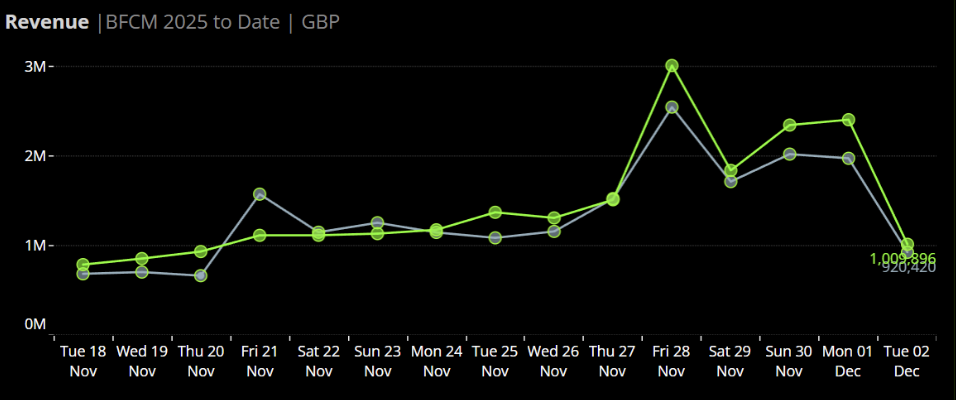
The usual ‘Fake Friday’ effect - a spike the Friday before Black Friday - was far less prominent this year. Instead, it aligned with the generally slower build-up, whereas in 2024 we saw a strong uplift on that day. The real momentum came across the key weekend itself, where the bulk of growth was delivered.
The biggest on-site trends this BFCM
Early access and gated offers
One of the clearest behaviour shifts this Black Friday for premium and fashion brands came from how they approached early access and private sale mechanics as part of their wider growth strategy. This has been building for a few years, but 2025 marked the point where early access moved from a nice-to-have VIP perk to a core acquisition and loyalty tactic.
Across both clients and non-clients, we saw far more brands gating their strongest Black Friday offers behind an account creation or an email / SMS sign up. The goal was simple: convert peak demand into long-term audience growth. This approach worked particularly well for brands with an existing membership or loyalty narrative, where the value exchange felt natural and aligned to their broader brand story.

Two examples from our own work were The Frankie Shop and P448. Both used marketing sign-ups in exchange for early access and saw strong subscriber growth and high engagement leading into the main sale period. For brands looking to strengthen their first-party data foundations heading into 2026, this kind of gated incentive is becoming one of the most effective tools available.
Early access also evolved beyond a single email send. Many brands introduced multi-stage journeys, starting with a “register your interest” phase, followed by personalised reminders, countdowns and gated onsite experiences. This created a clearer build-up, reduced reliance on last-minute traffic spikes and helped shape more predictable demand patterns.
Product discovery
Beyond early access, product discovery played a bigger role this year. More premium and fashion brands introduced curated edits, guided selling tools and lighter personalisation layers to help customers navigate large promotional assortments. We also saw an increase in loyalty-tiered experiences, giving existing members preferential windows, pricing or exclusive bundles.
Overall, 2025 showed a clear shift towards using Black Friday not just as a revenue event but as a structured acquisition moment and a key opportunity to strengthen long-term customer relationships.
Affiliate trends
The affiliate channel continued to evolve this year, maturing from a primarily last-click discount driver into a more sophisticated mix of content, influence and strategic partnerships. Last year we saw the dominance of cashback and a shift towards listicle-style content. While those trends remain core to the channel, the tactics we observed this year were far more nuanced. Here are the key trends we tracked across our client set.
The "value-add" over "discount-deep"
Historically, cashback has seen linear year-on-year growth across our clients, but the trend is shifting from aggressive rate increases to more strategic incentivisation. Rather than blanket 25% cashback rates that erode margins, more brands are adopting “stretch and save” tiered structures (e.g. Spend £150, get £20 bonus cashback) and dynamic commissioning based on customer value (new vs. existing).
"Black November" is the new standard
The advice to “start early” has evolved. It’s no longer about beating competitors by a day - it’s about sustaining share of voice for the full month.
As mentioned previously we’re seeing advertisers launch “VIP Access” or presale campaigns with exclusive affiliate partners as early as 1st November, complementing the early-access activity many brands ran onsite. By using top-tier content and influencer partners to build wishlists early in the month, and reserving high-incentive partners (cashback and voucher sites) for the conversion spike during Cyber Week, brands effectively covered the full affiliate funnel and delivered strong results across our client set.
The "gated" growth engine: CUGs delivered volume without erosion
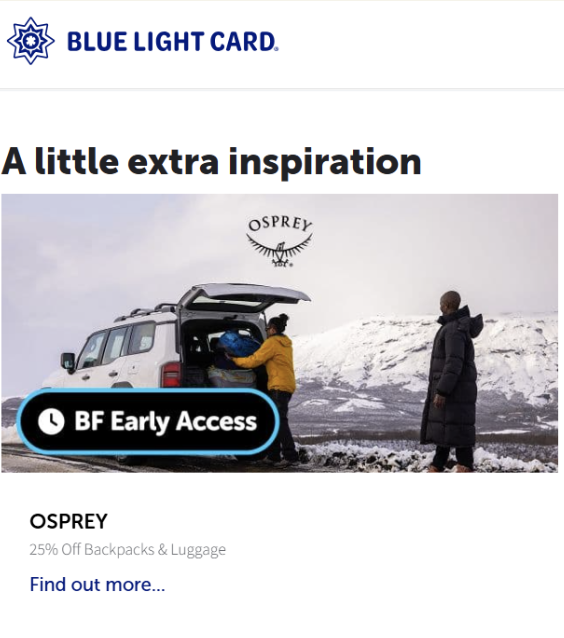
In a peak period defined by noise, Closed User Groups (CUGs) - particularly platforms like Blue Light Card and student discount portals - proved to be a powerful lever for high-volume sales without devaluing brand equity in the public domain.
Exclusivity is a strong conversion driver. While public voucher sites competed for the generic consumer, advertisers increasingly pivoted budget towards gated communities such as NHS workers, students and employee benefit schemes. By securing exclusive placements with enhanced offers (e.g. ‘Extra 10%’ off BFCM prices) brands tapped into highly engaged, loyal audiences that convert at much higher rates. Data from the period also shows that CUG members perceive “stacked” or exclusive rewards as a high-value benefit, often resulting in higher average order values.
Creative trends
As we move into the creative side of BFCM, one theme is clear - this year, less was more, especially for premium fashion creatives where simplicity and clarity tend to outperform. Consumers were ready for deals, and brands delivered with clear, direct creatives that got straight to the point. These were the top three creative trends from Black Friday 2025:
Straight to the point statics
Consumers were already expecting Black Friday deals, which led many brands to keep their 2025 visuals simple and let the discounts stand out. With audiences primed for promotions, straightforward deal messaging often outperformed richer, product-led storytelling. As a result, many of the top-performing Black Friday ads were static formats featuring simple, deal-focused text overlays.
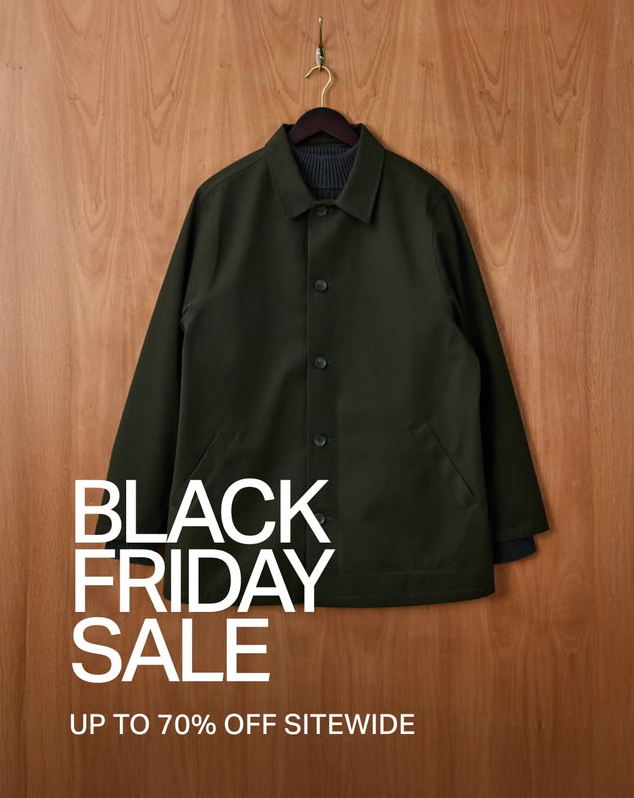


Examples from Burga
This approach focused on shoppers at the bottom of the funnel, where brand and product awareness must already be in place for the creative to be effective. Particularly for more modest offers (such as 25% off), effectiveness relied on consumers already wanting the product - making earlier awareness-building campaigns even more important.
Engaged animations
With the volume of competing offers, stopping the scroll can be a challenge. GIFs and animated creatives proved to be a powerful way to capture attention, adding just enough movement to communicate more context about the offer in just a few seconds.
Across our clients, subtle animation drove thumb-stop rates of up to 10%, showing that even light motion is an effective way to break through the noise and make an offer feel more memorable.
While statics held the majority of spend, GIFs and animations consistently ranked second or third across most ad sets. Content diversity continues to be one of the most important drivers of performance, helping avoid creative fatigue and reach different audience behaviours.

While statics held the majority of spend, GIFs and animations consistently ranked second or third across most ad sets. Content diversity continues to be one of the most important drivers of performance, helping avoid creative fatigue and reach different audience behaviours.
Ad to community (UGC and beyond)
The broader conversation around social media in late 2025 - through Black Friday and into the gifting season - has been centred on how digital content can support real-world communities and experiences.

Though UGC did not dominate Black Friday, the brands that leaned into community-focused activations saw strong results.
Why simple creative won
This year’s Black Friday ads can be summarised by simplicity. Many premium and fashion brands kept it straightforward and to the point, with most creatives centered on the deal rather than deeper storytelling. Consumers were expecting discounts and didn't need much additional context to convert - and as a result, text-heavy, deal-focused formats dominated. Clear messaging and bold visuals proved to be the most effective way to drive conversions during this intensely competitive period.
Final thoughts
Black Friday and Cyber Monday (BFCM) 2025 delivered a more measured performance, shaped by a high 2024 baseline, shifting consumer behaviour and a greater focus on long-term value over aggressive discounting. As brands begin planning for the year ahead, several themes from this peak period stand out as opportunities for stronger, more sustainable growth:
Build momentum earlier, using gated early-access mechanics to grow first-party audiences and warm demand well before the main sale window.
Keep messaging clear and conversion-driven during peak, while ensuring earlier awareness activity is in place to support performance when offers are more modest.
Prioritise creative variety - pairing simple, text-led statics with subtle animations - to capture attention and reduce the risk of fatigue across channels.
Leverage affiliate partners strategically, using content and influencer publishers for early interest-building, and reserving cashback and voucher partners for the high-intent conversion moments.
Explore Closed User Groups to drive incremental volume without diluting brand equity publicly, especially across categories where exclusivity is a key value driver.
Strengthen onsite product discovery and personalisation to help customers navigate large assortments and maintain momentum throughout the promotional period.
By leaning into these strategies, brands can balance short-term revenue with long-term customer value - setting themselves up for a stronger, more predictable peak season in 2026.
Subscribe to our newsletter
Our monthly newsletter is designed to be the most actionable and inspiring eCommerce newsletter in existence, combining examples of eCommerce innovation, benchmarking insights from the industry, and the latest news and eCommerce trends.
By signing up you are agreeing to our privacy policy.