
Black Friday 2023: Spending Behaviour, Creative Trends & Strong eCommerce Campaigns
Black Friday is without a doubt one of the biggest shopping periods of the year, marginally topped by the weekend before Christmas, for all of those last minute holiday shoppers. 2023 has been a year defined by high inflation rates and a cost of living crisis, and due to the poorer climate earlier in the year, a number of brands shifted targets into Q4.
Whilst the past few months have seen improvements in inflation (and consumer confidence is on the rise), value is still very much at the heart of the customer and their purchasing decisions. There was a lot of pressure for this period to perform and with the culmination of these factors, Google predicted this year to be the most substantial Cyber Weekend to date, with Black Friday as the peak spending day.
It seems like these predictions ran true. Google reported an 8% increase in retail demand YoY and Shopify hit a Black Friday record with $4.1b in sales, up 22% on last year - with the key categories sitting as clothing, personal care, and jewellery. Similarly, we saw a 28% increase in revenue across the agency. Whilst Google still accounted for the majority of spend, we saw clients investing proportionately more YoY across Meta.
The following article will take a deep dive into the areas we saw perform well this year, the key performance trends and what we feel as an agency contributed to this year's success. We’ll be reviewing the creative trends that worked well and the lessons we’ll be taking into next year, along with the eCommerce trends, what strategies brands deployed for pre peak data capture, and what we saw on-site resulting in optimum conversion over this key period.
Spending Behaviour and Efficiency
Budget and investment trends
Budgets and increased revenues
The following figures in this section represent the agency's internal insights into the 2023 BFCM period based on average, anonymised client data.
At the top line, total paid media investment across Google Ads and Meta saw a 39.9% increase across the full Black Friday week, with revenue generated increased by 28.7% as overall efficiency of campaigns dropped off from an average of 8.30 to 7.64. One of the most perceptible shifts in spend and revenue vs. 2022 is performance in the week running up to BFCM week, as well as performance during the Monday to Thursday of Black Friday week.
A lot of our brands ran a single offer starting as early as 7 days before Black Friday through to the end of the promotional period, meaning that sales could be secured early, especially if communicated to users that the offer was the final reduction for the period. Despite this higher baseline of revenue seen throughout the whole period, we also saw greater spikes on Black Friday and Cyber Monday which were up 39.7% and 53.6% respectively in terms of revenue.
In terms of platforms, advertisers increased reliance on Meta which saw 33.3% of the BFCM budget compared to 28.6% last year. It is important to note that both platforms saw YoY increases, with Google up 30.6% and Meta up 62.9%. Across Meta we saw Advantage Plus Shopping campaigns aided to drive the scale of spend YoY, with budgets through these campaigns up 7.2x compared to last year. The Black Friday weekend (Friday through Monday) saw the biggest YoY increase in spend for Meta, with that period seeing spends increase 89.3%. It is also interesting to highlight that reels, video and stories placements saw a disproportionate increase in spend. Google saw spend in this same period up 29.7%.
International markets saw a significant increase in spend, outstripping the UK in terms of growth in spend. Although the UK was still the top spending market across our client set, the US, Italy and Australia were among the fastest growing markets. Total revenue driven from the US across Meta surpassed the UK’s revenue figure for 2022 seeing 131% growth in revenue.
Cost of advertising
The following figures in this section represent the agency's internal insights into the 2023 BFCM period based on average, anonymised client data.
Traditionally we would expect to see the highest advertising costs for the year in Black Friday week, with significant YoY increases to CPMs and CPCs. This year was no different, with Meta hitting the highest CPMs we’ve seen. CPMs experienced a notable increase of 44.7% YoY across Meta. However, this trend was less pronounced in the UK, where CPMs averaged £10.16 during the BFCM week, reflecting a rise in 23.9% YoY. International markets saw a much greater year on year increase as brands look to diversify their risk across markets. The US is the standout market in terms of YoY trends, where CPMs were down 9.35% (although still benchmarked the highest of any country with an average £20.16).
Google’s CPCs achieved a robust YoY growth of 25.3%, averaging £0.62. Notably, regional variations differed from Meta’s trends. The UK’s CPC remained relatively stable, experiencing a 1.05% increase, however, the most significant increases occurred in the US (+36.1%), Netherlands (+39.6%), and Australia (+22.6%). Within campaign types, display and shopping campaigns saw the biggest CPC increases of 100.8% and 77.5%, respectively. Interestingly, Performance Max which encompasses these placements, saw a comparatively moderate CPC rise of 15.9%, suggesting Google are heavily favouring their newer automated product in the auction. In comparison, search campaigns experienced a 20.8% increase in CPCs.
Creative trends
In the run-up to and during the BFCM trade, consumers are naturally subjected to lots of creatives. Among the creative saturation, it was interesting to observe the methods and strategies employed by brands to not only seize individuals' attention, but also entice consumers to actively engage and make a purchase.
Once again we saw many brands fall victim to the pitfall of using soft messaging, with simple ads featuring the words “black friday sale” upon a black background, devoid of any further context. Amongst a sea of similar creatives, this not only fails to capture attention, but misses the most essential pieces of information - what are you selling, and what is your offer?
The most successful brands will have a considered look and feel for their BFCM campaign - one that fits within their overarching brand to attract those loyal bottom of funnel customers, but also champions the offer and stands out enough to activate new customers, and show that this is not just business as usual.
However, BFCM does not exist in a vacuum. The brands that did the best will undoubtedly be those that see best results year-round due to a solid foundation of BAU and storytelling creative. It’s hugely important to have your ad creative in a strong place in the lead up to Black Friday, as you want to make sure that your brand is already recognisable, and that your Black Friday creative both fits into that recognisable image, and gives the customer a reason to choose you over your competitors.
Brands using bright, digital first colours
This year saw a lot of the most successful brands moving as far away as possible from black in order to distinguish themselves from the pack. The brands that stood out the most went all out with bright neon colours, often over white backgrounds. Blues, purples and greens were paired with digital typographic treatments to reflect the online nature of shopping in the digital age.
The brands executing this most successfully were those who employed a distinct visual device, and consistently applied across all platforms. Pairing this device with clear messaging that champions the offer and imagery of the product (ideally being used by someone) was the winning formula this year.
Gymshark

Percival

Office

Quiet luxury
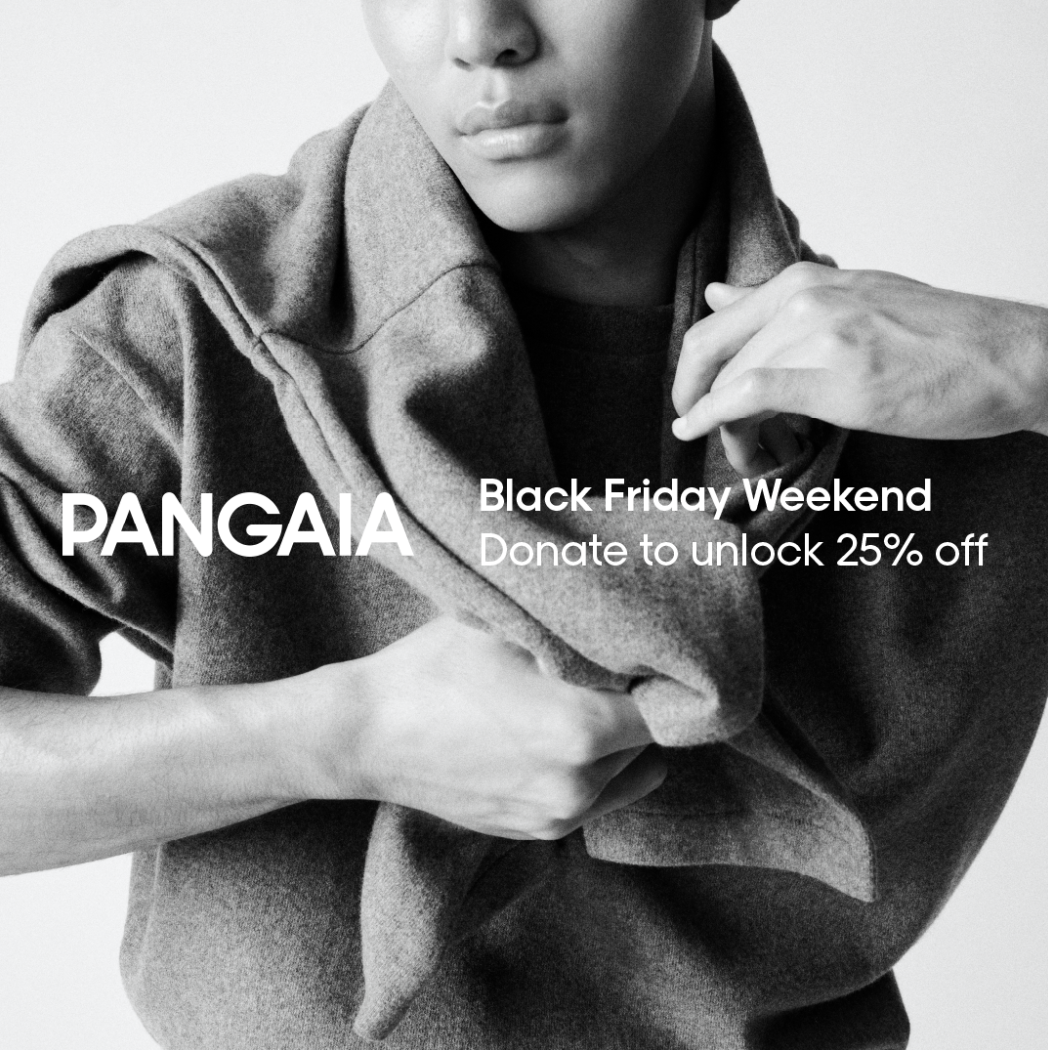
At the opposite end of the spectrum, we saw brands leaning away from the typical shouty nature of Black Friday sales language and opting for a more downplayed approach. They embraced a quieter approach featuring small, minimalist typography, elegant brand-focused visuals and lifestyle imagery, all of which was accompanied by subtle messaging. For brands whose image doesn’t necessarily resonate with the ethos of Black Friday, this can be seen as a more sophisticated move that will strengthen the brand’s integrity, and reinforce their image in the eyes of the customer.
PANGAIA
COS

Sustainability messaging (Green Friday)
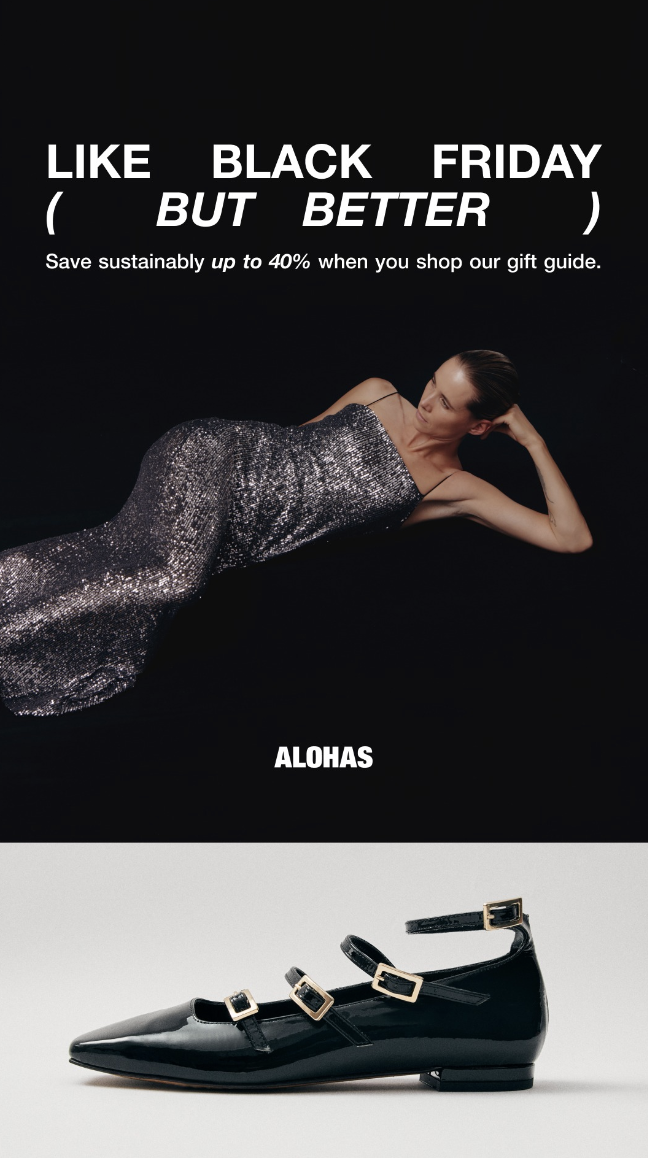
Continuing on from previous years, we saw even more brands adopting a conscious approach to Black Friday sales. Some offered deals that included the brand giving to charity for every purchase, or the consumer having to donate to charity in order to unlock the discount.
Osprey

Alohas
Organic Basics

On-site trends
Over the recent weeks surrounding Black Friday, Cyber Monday and pre-holiday season sales, we spotted an abundance of really strong examples of on-site UX - though there were a lot of parallels with some of the examples covered last year. The particular focus within this year's wrap-up is data capture and future retention.
Black Friday account data capture and app positioning
LSKD
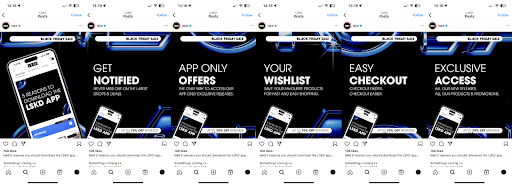
With many growing brands considering the value and utility of a dedicated app, something we really liked from activewear brand LSKD was the promotion of their dedicated application ahead of Black Friday. In the days leading up to the sale period kicking off, customers were encouraged to download the app in order to receive access to their product discounts. What we also really like here is that the whole customer account value proposition is highlighted within the same post, calling out the benefits of:
- Being able to checkout faster (particularly beneficial when items are selling out fast when on sale).
- Exclusive access to new releases.
- Ability to use a wishlist to streamline the shopping experience.
- Push notifications - be notified on the latest product releases and promotions.
The main thing to highlight here is the importance of encouraging customers to sign up. This forces the customer to then create an account which results in a brand being able to collect significantly more first-party data around the customer. This data can therefore be pushed into the CRM to create a more guided, personalised experience, be it via product recommendations, email flows or more.
On-site notifications and promotions
Asphalte
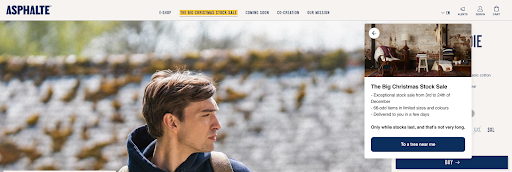
Something we’re seeing more frequently is on-site notifications, in-line with the style of notifications on Instagram, eBay and resale giant Vestiaire. We really like the execution of this from men’s clothing brand Asphalte. The on-site alerts were being used to highlight seasonal sales, outlining the date of the sale, number of items in the sale, as well as delivery reinforcement messaging.
This is a feature we expect to see a lot more of in 2024 and something we recently helped implement on The Frankie Shop- this execution is particularly nice as it pushes the styling and customisation of the Wisepop’s integration to a higher level.
Rolling Instagram livestream growth hack
Represent

We highlighted an example of a neat growth-hack via Instagram’s live streaming from New York based brand The Arrivals in last year's blog, and the ability to have a persistent story-like presence by virtue of livestreaming on Instagram.
This year, our client, Represent, ran a similar livestream on their Instagram account. However, this example was more cryptic, as part of the mystery story involved the founder George Heaton being abducted by aliens in the lead up to their Black Friday sale. This stream amassed a large number of consistent viewers at any given time, which promoted conversation about the brand among their loyal following. This ultimately led to discussions around how to access the gated discount for members, subsequently building hype.
Final thoughts
While Black Friday is always going to be a key trading period, it felt slightly different going into this year, given the economic climate we have experienced. It was great to see some really solid uplifts across revenue - but, as expected, rising costs did mean efficiency took a slight hit, and this year it was interesting to see the extent of this across Meta and international activity. Moving into next year’s BFCM planning there are a few key areas which we observe could drive even stronger performance;
- Avoid soft messaging and simple ads, which don’t give context.
- Leaning into AI powered solutions such as Advantage+ can help drive additional scale.
- Pre-BFCM lead gen works well to gather consumer data and target a new audience that has already shown a level of interest.
- On-site notifications are a beneficial mechanism to remind consumers of offers.
If you would like to discuss your eCommerce strategy, or how to approach creative and visuals for your brand, get in touch.
Subscribe to our newsletter
Our monthly newsletter is designed to be the most actionable and inspiring eCommerce newsletter in existence, combining examples of eCommerce innovation, benchmarking insights from the industry, and the latest news and eCommerce trends.
By signing up you are agreeing to our privacy policy.