
2025 eCommerce Trends, Predictions & Benchmarks - Focuses across International, Brand & Technology
As per the last few years, I wanted to put together a bit of a summary of the trends and focal areas we're seeing amongst clients going into 2025, along with some of the key highlights from 2024. The core areas I’ve focused on are growth markets (and predicted growth markets for this year), roadmap and new feature focuses, general areas we’ve seen higher investment, what’s worked for our clients and areas we think will become more important over the course of 2025.
The core areas of this blog post are:
- eCommerce and marketing predictions for 2025 (with predictions from Josh on the marketing side also)
- International trends - growth markets, new focus markets, investment markets etc
- Loyalty, VIP, clienteling + customer data strategy generally
- Investment in top-of-funnel experience + managing low intent traffic
- Increased investment in end-to-end brand experience and artistic direction
- Actual usage of and adoption of AI amongst client teams
- Measurement and reporting - how to approach, what's working, key investment areas
- Tech consolidation + simplification
- 2024 trade + learnings
eCommerce predictions for 2025
The first of these predictions are from myself and Josh Duggan, the Co-Founder of Vervaunt. The second set are then from people in the industry that we asked to contribute to help broaden the areas covered. Below we then cover the trends we're seeing across our clients.
Agentic AI will become more mainstream and become a bigger focus for most types of businesses (Paul)
Agentic AI or the concept of an AI agent being able to fulfil aspects of a role or a whole role is something that’s getting more buy-in and something many are investing heavily in (something we’ve also started looking at). Lots of big tech companies are approaching product and GTM in this way also and I think the concept of ‘agents’ will be how many approach AI adoption and investment. I've now seen a number of tech companies with products sold as replacements for specific roles across various sectors. The most common proven examples so far are mostly around support and programming, but I think we'll start to see this impact more entry-level roles in digital generally (e.g. eCommerce production, SEO, paid media etc).
Google AI will have much bigger influence on search experience (Josh)
Google will continue to push the exposure of their AI results in search, with it being fully live across the US now for a number of months and soon to reach more than 1 billion global users each month. The impact on paid will be limited, with the majority of queries impacted being informational (non-transactional) but we can expect to see it influence paid and particularly shopping more over time.
Currently Shopping ads appear above AI overviews 80% of the time and Google is naturally being cautious with any changes which can impact paid clicks. Google will, however, quite quickly want to support with more complex questions that might have previously taken multiple searches or follow-ups. Chat responses will cause user queries to be more precise and include much more intent. Advertisers will need to ensure their PDPs and product feeds are optimised to handle and index against more specific user queries.
The eCommerce services market will become more competitive and further commoditised / consolidated, leading to more niching and more specialism focus (Paul)
I think we’re seeing the two biggest impacts on the service industry around eCommerce ever; which are Shopify and the advancement of AI (and we’ll likely soon start to Shopify’s usage of AI also). My prediction is this will continue to reduce overheads and barriers in a number of service areas (e.g. building of a site, selling cross-border, the bottom ~30% of marketing etc) and also see different categories of service providers starting to compete for budget (e.g. marketing agencies, development agencies, consultancies, freelancers etc). This will leave vertical experience and strategy as the two main areas for differentiation. On a more positive note, I think there remains significant opportunity across most categories in the short-term with many larger brands moving away from large, enterprise vendors and moving to more agile specialists. Lastly, I think the above will lead to vendors honing in on niches and building and developing more specialist products and services in order to adapt.
YouTube will adapt strategy to target lower funnel KPIs and budget (Josh)
YouTube is the world's largest platform for video content consumption, however it’s ad revenues are only a fraction of Meta. I expect to see a lot more from YouTube from a product perspective with a focus on this. Measurement will be a big focus and new campaign types aimed at delivering more success to lower funnel KPIs will justify more budget being tested here.
BigCommerce will be acquired, alongside one more major commerce platform change (Paul)
BigCommerce selling wouldn't be a surprise to many, but a number of recent moves and the general situation they’re in suggest that this would be a good option for them to continue progressing. I then think Commerce Tools will be the second platform with a big change in ownership structure. It’s been ~3 years since their last round of funding, they hired a new CEO last year with an assumed exit goal and it feels like they’ve been preparing for their next move for a while. Rumours have been largely around an IPO, but I think it could be that or an acquisition personally.
TikTok will not get banned in the US (Paul)
Although it’s not looking great presently and there’s a risk of Bytedance not being able to properly maintain the app very soon if the ban goes through - I personally think there's too much money in discussion here and there’ll be some level of agreement or change in ownership that results in TikTok remaining in the US market. I’m not as well educated as some of the analysts that have looked at this, but I have been doing a lot of research and listening to a lot of educated views and I can’t see there not being a resolution that meets the needs of both parties.
Brands will be forced to diversify their media mix and put more thought into content (Josh)
Many brands have maintained a consistent media approach over the last few years; with heavy investment in Meta, some testing with TikTok and other channels (existing content repurposed for social) and then Google activity to capture low funnel demand (brand and shopping). The world has evolved and brands (especially with lesser demand) will start to focus more on building platform-specific content, creating audience-first content, be more aggressive with testing content types (e.g. running UGC on TikTok) and building a more considered media plan which combines cost of content in ROI measurement.
TikTok is still growing and brands slow to launch on the platform are stepping into a more challenging environment. Average brand follower growth is down 30% YoY and it’s only going to become more and more difficult to build coverage organically. We expect to see more and more brands investing more across TikTok however all metrics are suggesting it’s becoming more competitive and costly every year.
Shopify will step up their focus on first party data (Paul)
I personally still think first party data is one of Shopify’s two main missions and I think they’ll step up their attempts to house more global data in Shopify (potentially addressing the current need for a CDP in the medium-term) and also have more ownership of customer account data in particular.
Salesforce Commerce Cloud and Adobe Commerce Cloud will continue to lose (B2C) market share at every level (Paul)
Sadly, I think both of these platforms have now got to a point of no return, with many aspects of the platforms and their eco-systems just not meeting today’s expectations of retailers (whilst also not being able to compete with Shopify’s R&D budgets and some of the emerging platform’s agility). I think there’ll be further shifts towards the SaaS platforms (including the likes of Centra, who are challenging in Europe) for brands and I still see plenty of opportunity in the complex or large B2C retailer space, which will likely take a little bit longer to see these platforms displaced (but it will still happen).
Although many of the larger retailers have developed a lot of IP and bespoke functionality generally around the platforms, there's a huge amount of frustration from everyone I speak to about the ratios of investment, costs in general and lack of development across both platforms (and lack of quality when things are brought to market). Outside of Shopify and Centra (the platforms we’re most bullish on), I think Scayle and BigCommerce are still well placed to challenge on some (be it lower volume) net new larger retailer deals.
US trade will be more positive for brands in H1 (Josh)
Over the past 18 months, there has been considerable speculation about US trade, with inflation remaining 2x what it was in 2015 and predictions of a recession have been a recurring theme among economists. However, with resilient consumer spending, steady labor markets and less restrictive monetary policies, these concerns are diminishing. Overall, there is a growing trend of positive predictions for the US in the coming year, especially since the election. Consumer spending in the US has only increased quarter-on-quarter since Covid, the S&P is up 26% YoY and generally there has been on a consistent incline since early 2023.
Moving into 2025, we are pretty confident in the US market - our clients were up +20% YoY in the US in Q1 last year and up nearly 30% in Q4 YoY. As we move into 2025 we see all signs suggesting positive trade and opportunities for brands.
The following predictions are from industry experts that we asked to comment on some of the trends they're seeing in their areas.
Retailers will start investing in a new tech eco-system, not just a platform (James Gurd, Founder of Digital Juggler and Co-Host of Inside Commerce)
There are two complimentary tech evolutions that have resulted in a rethinking of the role of an ecommerce platform: composable commerce and the rise of SaaS.
In 2025 and beyond, an ecommerce platform has to deliver connectivity and flexibility, it doesn’t have to provide every last piece of functionality an ecom business requires. For example, a robust API layer and integration capabilities to plug-in loyalty and referral platforms without the vendor needing to build best-in-class native to the platform.
This is important for several reasons:
- No single vendor can build & maintain market leading functionality across all areas of ecommerce
- The more complex a single platform, the greater the likelihood of bugs and additional maintenance effort
- Choice is paramount for ecommerce teams to pick & choose which 3rd parties best align with their strategy
- Speed-to-market is essential, where piloting and MVP approaches enable rapid, lower risk deployment
It also changes the approach to replatforming. Replatforming is no longer about just picking an ecommerce platform and doing a lift and shift; it’s about building a new tech ecosystem around the ecommerce platform, selecting other 3rd parties that best fit with it. Sometimes an ecommerce business will need to part ways with a trusted partner simply because they don’t support the new ecommerce platform, or will discount an ecommerce platform because it doesn’t have a deep enough integration with a mission critical 3rd party.
B2B commerce evolves to focus more on UX and user journeys (James Gurd, Founder of Digital Juggler and Co-Host of Inside Commerce)
B2B is set for a strong 2025. Gartner predicts that 80% of B2B sales interactions will occur digitally by the end of the year.
Where things are changing is in the focus on UX and user journeys, as satisfaction with online shopping lags behind B2C. A 2024 global survey found that 38.4% of B2B buyers reported having a negative or somewhat negative online shopping experience.
With many modern B2B buyers executing a B2C like shopping experience, solutions will evolve from focusing on buyer portals to providing richer brand experiences, deeper personalisation and improved product discovery. I’m already seeing more B2B merchants invest in specialist product discovery engines like Klevu, as well as content personalisation platforms like Nosto.
Supply Chain Transformations Driven by US Trade Policy (Luke Hodgson - Founder of CommerceThinking)
The potential shift in US trade policies and tariffs is poised to fundamentally reshape how brands operate in 2025. We predict:
- Major brands will accelerate their supply chain diversification away from China and Mexico, establishing new manufacturing partnerships in alternative regions
- A possible reduction in the $800 de minimis threshold will drive brands to establish US-based 3PL partnerships or distribution centers
- Investment in advanced Business Intelligence BI and ERP systems will surge as brands seek to model multiple scenarios and manage increasingly complex supply chains
- FP&A teams will require more sophisticated tools to handle evolving tax and duties structures
Brands will invest in more robust inventory management solutions (Luke Hodgson - Founder of CommerceThinking)
Rising costs across customer acquisition, supply chain, and storage are pushing brands toward more sophisticated inventory management.
Weʼre seeing increased adoption of specialised inventory management platforms like Style Arcade, and Madden within fast growing brands, and larger enterprises developing custom solutions within their BI/Analytics infrastructure.
These tools rely on accurate actuals around sales, purchasing and movement of inventory. So brands will continue to implement unified ERP systems (e.g., Netsuite, Dynamics, Fulfil, Accumatica) to create single sources of truth for inventory transactions. The ones who actually do this properly (vs under estimating effort and giving up too soon) will establish a competitive edge.
The name of the game is enhanced focus on clinical procurement and promotional strategies to minimise slow-moving and dead stock.
Growth of No-Code Platforms (Luke Hodgson - Founder of CommerceThinking)
The no-code and low-code trend will evolve. Airtable will continue as the preferred solution for straightforward use cases, and with recent feature releases itʼs ability to handle complexity is improving. Retool will be used to handle more complex workflows requiring advanced security and large data volumes. AI- powered platforms like Cursor will gain traction, enabling rapid application development without traditional coding.
The greater awareness of these tools and how to use them within brands, will lead
to more migration off spreadsheets into small, purpose built no-code apps.
GenAI becomes more utility rather than just interesting novelty (Liam Quinn - PT Technical Director at Vervaunt)
I agree with Pauls' points around the rise of agentic AI and its impact on eCommerce. I've been playing with this technology for a couple of months and it's already pretty accurate in AI ability to replicate common browser based tasks - with speed and cost currently the biggest blockers. This landscape will look very different in ~6 months.
Alongside that I think Generative AI we will see move from mostly being a cool talking point, and a few brands creating ads mainly for the PR around how its been made - to actually genuine utility where it is consistent enough to make a huge impact. In written content and image assets as we've seen, but also video assets, granular onsite personalisation and code generation.
Omni-Channel will play a bigger part in digital marketing (Freddie Ransom - Performance Team Lead at Vervaunt)
For brands which have bricks and mortar, 2025 represents a strong opportunity to collaborate both the online and offline experience more frequently.
From localised inventory feeds to drive more traffic to click-and-collect and ship-from-store, there’s a clear focus, particularly from Google, on driving this type of customer journey through digital marketing channels, for example, Performance Max for store visits.
Additionally, the role of a physical store will be crucial in conveying a brand experience which can be slightly trickier (not impossible) to achieve digitally-facing. Research and inspiration typically takes place via the digital channels, but, being able to identify quality, fit is an area a store excels in. This is particularly relevant as the product demands from consumers continue to evolve and become more challenging.
More investment in community from brands (Freddie Ransom - Performance Team Lead at Vervaunt)
Inspired by the likes of Aimé Leon Dore, brand building is looking to stretch beyond a transactional relationship. Brands are creating spaces such as Café Leon Dore and Ralph’s Coffee (Ralph Lauren), which has been an inspiring way to encourage community outside of their typical offering. It adds to the brand immersion and feels exclusive for loyal shoppers. Not only this, but it creates a buzz and interest for new potential customers.
In a different case, Cole Buxton once tried their hand at community-focused NFTs - although maybe not the right approach for 2025, it’s still great to see a brand trying something new for their community - we expect to see this more and more next year.
Finally, Represent (and a number of the running brands out there) have used their fashion platform to create a fitness group / run club. Again, creating authenticity for the brand and community building. Additionally, it has allowed them to break into the activewear space and create a more diverse product offering.
Focuses amongst our clients going in 2025
In this section, I'm focusing on the biggest trends we're seeing as we plan for 2025 with our clients and also from conversations with brands we're close with. As well as 2025, I've also factored in the biggest investment areas and focal areas for clients in H2 2024.
1) More focus on entering and scaling new markets
I don’t think this will be a huge surprise to anyone, with this being a big trend for the last ~2 years, largely as a result of varying levels of economic strength in markets, investment terms (or aim to increase valuation), market capping, and costs of advertising. It’s also easier than ever to sell cross-border - with pretty much every aspect seeing some level of commoditisation (fulfilment, finance, translations, payments etc). Looking into 2025, this remains the big trend we’ve being covering with clients recently, with many looking to slightly different markets than the core UK, EU and US focuses.
The US remains the biggest focus amongst our clients and represents ~25% of our media spend. We are also seeing more growth and demand from wider regions across the US and North America, which is positive - as the primary cities and states are a big driver of the high CAC. It’s still fundamental to maintain tighter geo activity than other markets with a focus across cities where you already have demand to see initial success, then scaling into similar regions and cities over time. We work with ~40 premium fashion brands and are beginning to use shared insights across all brands to determine micro-regions where each may under index in revenue.
Key growth cities amongst clients include Houston, Washington DC, Denver, Austin, Phoenix, Charlotte and Salt Lake City, as examples of cities over indexing Vs our general US growth.
Despite the obvious appeal of NYC, one example is that it’s 24% more costly to serve an ad in New York then Texas (generally a top 5 revenue driving state for our clients). We are also seeing an increasing proportion of US revenue coming through states outside of NY and California and we expect to see more volume and activity being pushed into wider regions across the US. Texas is also seen as a big opportunity state for many brands (including retail in Austin and Dallas) due to the rate of higher net worth individuals re-locating there from other key states such as New York and California (largely driven by tax benefit and investment in key areas).
From a content perspective in the US specifically, we are seeing recent success through campaign and lifestyle content showcasing a variety of models. There’s also a trend of premium influencer activity which looks more polished (like a campaign shoot), as well as product imagery visuals with engaging transitions to focus more to the lower funnel.
The biggest new emerging markets we’re currently seeing brands invest in (from both a localisation and marketing perspective) are Japan and the Middle East, both of which have strong economies and a high proportion of high-income and affluent residents. They are also markets with an affinity towards premium fashion. Although they are not easy markets to localise, consumers in both regions are comfortable with buying internationally, with Japan’s cross-border spend growing by ~6% this year and total annual spend expected to exceed $5bn by 2030. The Middle East cross-border spend is expected to grow considerably over the next few years, reaching a projected revenue of nearly $50bn by 2030. The growth in online shopping in the Middle East over the last 5 years has also been widely publicised.
Key growth markets for our clients this year were:
- Germany is +12% YoY across our client base with generally strong results throughout the year.
- Canada has remained strong. 2024 was +36% YoY for our client base. The cost of fulfilment for this market can often reduce the level of focus here, as this impacts profitability for many.
- Japan and the Middle East are very strong markets for growth. We saw +49% YoY for Japan and +77% growth for the Middle East and have also seen spend increase considerably in H2.
- Australia would be the final call out with considerable growth. More recently in Q4 we saw +20% YoY. 2024 in full was up 11% Vs 2023 (it was also a key growth market in 2023).
- France was certainly one of the more challenging markets with revenue -17% on the year; -29% for Q4 specifically. Likewise Italy was another challenging market, seeing our largest revenue decline for the year at -26%.
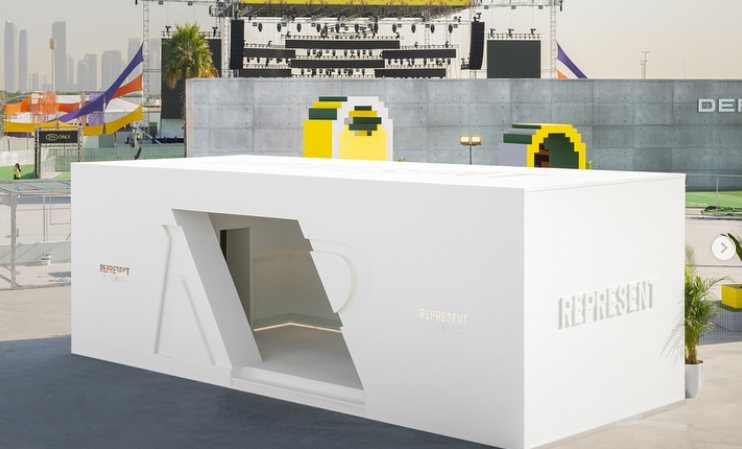
Both Japan and the Middle East are quite retail focused. One of our clients Represent (who we often cite as a great example of how to manage wholesale well) have done some really cool activations with Ounass, the most recent of which can be seen below. I really like how they tend to do more partnership marketing and joint activation activity with wholesale partners, which have included run clubs, in-store events and stuff like this.
Key growth markets for 2025 include the Middle East, USA and various European countries. The US remains a prime target for expansion, with a significant opportunity for brands to grow (and some UK brands already achieving greater success there than in their home market). However, the costs around entering the US market are prompting some brands to turn their attention to the EU, which can be more cost effective and existing marketing efforts and brand demand can go further. The Nordics also present a growing opportunity, with the added benefit of lower advertising costs on Meta compared to the US (3x lower). Finally, Japan is experiencing significant year-on-year growth for many brands with Google still dominating the search market allowing more ease to advertise with Yahoo! Japan and LINE representing other key channels.
2) Broader strategy around customer data and clienteling
Another one that won’t be a huge shock to most is that 'loyalty' remains a big trend amongst our clients at the moment, with many re-building and re-thinking their program with broader goals.
Although not strictly only loyalty, many are trying to incentivise building accounts, with a view getting more users logged in when browsing (aids personalisation, tracking etc), but more importantly to identify users across other channels (particularly retail). Many brands are trying to build effortless routes for in-store interaction with accounts and loyalty (think Soho House check-in), helping to create more interesting data points beyond just tying purchases back to an existing customer. The other goal for the accounts (and inadvertently loyalty) is to collect more relevant data to provide the most performant experience.
I would say this is a theme across all levels, however more luxury and premium brands we work with are positioning this more around the VIP, private client and clienteling space, but the core structure and approach remains the same (and goal of driving more revenue per customer). I would say that private client management is a big trend in itself, with brands adding more resource to their management of VIPs and HNW individuals and creating additional channels for shopping (WhatsApp, phone etc) and more convenient routes to shop and receive items.
I wouldn’t usually cite Forester or equivalents, but this quote is pretty in-line with what we’re seeing and the focus coming from more senior stakeholders in brands and retailers.
“Investment to unify data for the loyalty and marketing tech stacks will triple.” Forrester
One thing that still surprises me is that more of the leaders in the CDP and CRM space are not doing more around loyalty and VIP - given that they have the data and reporting in place and could easily build deeper integrations with the right vendors or even build out loyalty functionality themselves. I think we’ll see a lot more consolidation in this space.
3) More intentional on-site experiences for top-of-funnel and low-intent traffic
The majority of brands that we work with will have digital advertising as one of their highest cost lines on their P&L - often, the majority of this traffic is from users who have no prior knowledge of the brand and has no purchasing intent at all. Alongside this, many (rightfully) are then also investing more in content, creative and attribution to help push better results and justify expenditure. One of the things that always surprises me is how little investment and consideration there is then in the experience for the top-of-funnel segment of this demand. Some things we’re seeing more of our clients starting to review are:
- New customer landing experience - blending brand messaging / stories with product / collections. I often use this example from ON - which I was served as a prospecting ad for running interest - as a good example.
- New customer journey - beyond the initial landing page, one thing we’re gradually moving to with eCommerce brands is injecting different content based on segments, starting with new and returning and prospecting. We’re currently in the process of testing this with a number of clients.
- Metrics to judge the success of top-of-funnel activity (in that the majority have no intent and are unlikely to purchase straight away) - e.g. softer conversions (email sign up, account build etc), depth of experience (PDP visits, interactions with different elements, engagement with certain content etc)
Going back to the international point, this becomes even more important when you have little to no brand awareness in a new market.
4) Investment in brand and engagement across broader touch points
As more brands look to stand out amongst an increasingly competitive landscape, the big area where many have invested most in is content and the end-to-end brand experience being delivered online. I would say investment in art direction and content has been another of the biggest trends we’ve seen in the last two years, however this has gradually started applying to more of the industry beyond just premium brands. The main reason I've called this out also is that I think lots of brands have neglected these areas over the last few years, focusing instead on acquisition strategy and ad creative in isolation.
Example investment areas include:
- Engaging features - again, a big trend for brands to try and build more engagement for users at different levels of the funnel - examples include this gift finder and shuffle functionality from CELINE, Vitra’s Chair Finder, ON’s community stories and Nudie’s transparency content. There are many more examples, but these I really like as examples of premium brands investing in core functionality to make an experience more engaging and more unique to the brand. A general part of this I’ve seen more focus on over the last ~6 months is curation - addressing low-intent users who are browsing product.
- Product photography and media - this has often been highlighted by the brands we work with as one of the biggest investment area for them - typically investing in more advanced equipment, in-house studios and more experienced professionals to create more unique images that reflect the brand's premium positioning. Alongside this, other investment areas include the models and the full usage of content, different formats to support different types of ads etc, types of media (including video and 360 assets) and more tailored content for specific regions, cultural preferences and consumer expectations. I’ve always used The Frankie Shop as an example of a brand that invest in excellent photography.
- Ad creative - this remains one of the most important elements of scaling upper funnel. Brand loyalty is declining, CPMs are rising, and consumer expectations are increasing and this has created a massive need for brands to introduce more engaging, upper funnel content. Content now needs to be sharable, and it needs to capture attention and break through all the other content being consumed. For brands to engage net new customers in an ever increasingly saturated space; brands will need to create content which is: 1) Sharable and entertaining: mix audio, visual effects and creative storytelling to provoke an emotional response, 2) Capture attention: generally UGC content performs well here but you need your content to capture attention and deliver most value from every impression, 3) Relevant and relatable; we need creative diversity which allows us to build content which attracts and speaks to different audiences and buying personas, and 4) Digestible; combine pace, value and clear communication to deliver a succinct message.
- Overall direction of the theme / digital styleguide - many brands have commissioned re-designs recently with a goal of making the general aesthetic and feel of their “digital flagship” more premium and intentional, with examples from our clients including The Frankie Shop, P448, Self-Portrait and upcoming examples including Strathberry, Current Body, OKA and This Works.
The underlying point here is that the cost of a first impression is so high now, that the need to make that first impression unique, positive and have some lever to get that user bought in is critical, so all touch points matter. The costs associated with many of these areas isn’t huge also.
We’re also seeing our clients continue to invest in the creator economy and we believe YouTube will play a much larger role here next year - going head-to-head vs the likes of TikTok and Meta, which are seen as more creator-first platforms currently. New formats in Beta on YouTube include partnership ads, creative takeovers and their affiliate programme which recently integrated with Shopify.
5) Data + measurement investment, strategy and capability
This has been a bit of an on-going trend since the iOS changes and since the shift to GA4 really, but I still don’t think it’s been nailed by many (aside from those with in-house data teams and processes). Many have invested in buying an off-the-shelf BI platform, which are often good, but these tend to only cover the higher-level business reporting, rather than the more granular areas of reporting that specialist teams need. And often, businesses want to be able to add custom reports and views also. You also have the age-old problem of “sh*t data in, sh*t data out” with most of these pulling data from Google Analytics (GA), Meta etc.
The general gaps we see are:
- Behavioural reporting (how people are using the website)
- Attribution data, with a model or approach that everyone is happy with or confident in
- Holes in GA4 data or other forms of tracking used for broader reporting
- Customer reporting (broader customer value reporting, tying together data from multiple channels etc.)
You can’t get away from on-going investment in analytics and tracking anymore, be that via a retained specialist, an app or third party to safe-guard the tracking (still not really enough on its own), semi-regularly auditing or a full-time hire. Full accountability in this area is also worth investing in (especially if you’re using this data for attribution / to make big decisions).
If you have the budget, in-house capability on some level is also really helpful for more advanced reporting (e.g. more advanced trading data, inventory reporting, more complex channel reporting etc) - likely moreso on the data management side (building / maintaining connectors, stitching data together, data transformation, visualisation etc). Data Analysts within digital or finance teams have been quite common hires we’ve seen over the last 18 months.
Many have bought solutions like ContentSquare to address the gap in behavioural tracking (where they would’ve previously used the UI within GA) but, whilst it’s not a bad product, it’s very expensive and still requires a lot of work to get the most from. We’re now recommending a combination of FullStory or Mouseflow and GA reporting as a better value alternative (be it not as comprehensive).
Attribution has seen considerable change over the last few years, primarily due to privacy and tracking changes and increased media spend requiring more clarity on results. As a result, we’ve seen lots of third party tools thrive as brands look to further understand the impact of their investment. We generally group the area into two areas, which are:
- Measurement provides more data behind every user's touchpoint. Less focused on attribution modelling it will give much more context behind how a user has engaged with the brand and site e.g. 10 visits before purchase, saw x ad first.
- Attribution would be more focused on giving a calculated contribution behind every £1 of media spend and the ROI it achieved based on the incremental revenue driven.
Moving into 2025 we expect to see considerable developments from Meta and Google especially, with their Robyn and Meridian solutions in particular. We are using these tools currently and they have been super effective in terms of showcasing how incremental revenue has been driven from media channels. They showcase contribution over time, carry-over response (the % of revenue which is achieved but at a later date) as well as response curves showing a diminishing returns curve for each channel. We expect to see more brands leaning into these tools and MMM as a form of attribution whilst they also look to be more strategic with measurement and also understanding what ads are delivering most success during the first touch point for instance.
6) Consolidating of tech stacks
We’re still seeing lots of brands looking to reduce the number of vendors they have, simplify the management of various areas of their site (particularly trading elements), integrate more channels (a big lure for Shopify remains their POS solution and now their more sufficient B2B offering) and then reduce wherever possible. I think Shopify will push more into areas like reporting, personalisation / segmentation, subscriptions (going deeper in this area) and various other areas which will also drive more of this consolidation also.
Although often the goal is to reduce cost, that's certainly not always the case and many of our clients are investing in new technology - the key up and down areas I would say are:
Areas where clients are investing more:
- Reporting - as above, more investment in tracking + analytics and then also in building out purpose-built reporting.
- OMS - a number of clients have bought OMS solutions or paid for solutions to be built out to support things like pre-ordering, ship-from-store, better utilising inventory from other warehouses etc.
- Native app vendors - largely for Shopify brands, but lots of clients are responding to positive retention numbers being cited from apps. We've seen really positive impacts from introducing native apps when there's a proper strategy behind this area.
- ERP - still seeing brands buy solutions like Netsuite and Dynamics 365 as they scale up, rightfully or wrongfully.
Areas where clients are investing less:
- PIM - we've seen a number of clients remove PIM solutions or move to more lean, lightweight options like Airtable.
- Independent solutions for search, merch and recs - this is one of the biggest areas for consolidation.
- Enterprise personalisation and A/B testing - moving to more lean, modern solutions within platform eco-systems.
- Independent B2B products - seeing clients hold off on buying solutions like Joor and NuOrder, instead using native functionality from their platform or holding off until more widely used (rather than just buying externally).
7) Ship from store + inventory utilisation
A number of our clients with large retail footprints have either recently rolled out or are in the process of investing in ‘ship from store’ functionality. We saw this come up a lot last year and, as brands are starting to plan for 2025, this has now become more of a real investment area. Although there are obvious operational considerations, platforms like Shopify and Centra (and then solutions like Ingrid and some of the OMS solutions on the market) are making this far easier to roll out also. Brands we’ve spoken with that have rolled out for faster delivery have been very positive about the impact and customer experience.
Alongside this, I've also seen clients generally trying to leverage available inventory from other warehouses to facilitate for demand in other markets.
8) Last mile delivery as part of 'city strategies'
As above, brands are seeing faster delivery as a priority, particularly in key cities where they are trying to drive growth and sometimes compete with resellers - these cities are usually London, New York City, Los Angeles and a few key European cities. This has been more across premium brands, but again the feedback has been positive from clients that are using solutions like Quiver, Harper and other local carrier options, with users also willing to pay for the faster delivery (also a great loyalty benefit).
9) Influencer content ownership
In order to get value from influencer investment, brands will need to negotiate full ownership or think broader with content, due to the risk of low engagement, reach and high fees when approached in isolation. We will also see a closer blend of influencer and brand content; influencer content looking more polished and coming across though it was shot from the brand's own shoot.
10) WhatsApp marketing
A number of clients are testing this currently (with an initial focus on Germany, which is the most relevant market where it’s more common). We haven’t had much back on impact yet but plan to draw some trends over the next couple of months. I can only imagine this will become a bigger channel in 2025 and we’ll see it grow in more markets and see it become more accessible via mainstream CRM products etc.
11) AirTable generally
We're seeing people build or buy Airtable-based solutions more and more, with lots of CTOs and Finance teams bringing the topic up. People like Luke Hodgson and Ollie Rhodes have built solid offerings and regularly post about the value of AirTable (and other low code / no code solutions) for PLM, PIM and other core operational areas of eCommerce. I’m personally a fan of low-code and no-code solutions and I think the nature of their integration focus makes them very appealing when you start thinking about AI and also working more with SaaS products like Shopify, Klaviyo etc. I think we’ll see a lot more of Airtable and low-code / no-code in 2025.
12) Adoption of AI at different levels
I think this is the first time I’ve commented on AI where a lot of our clients are starting to use it, with the majority being focused on content editing, translations and flags or QA. More technical team members have now started building products that are becoming more widely used in businesses and there are also some great tools being made available very fast, with Emfas being one I’ve been really impressed with recently and solutions like.
I also saw this amazing example of a developer using Gadget.dev's AI with Shopify (via the API) to build out app-like functionality being cited on Twitter / X, which I think is something we'll see a lot more of.
13) Gifting
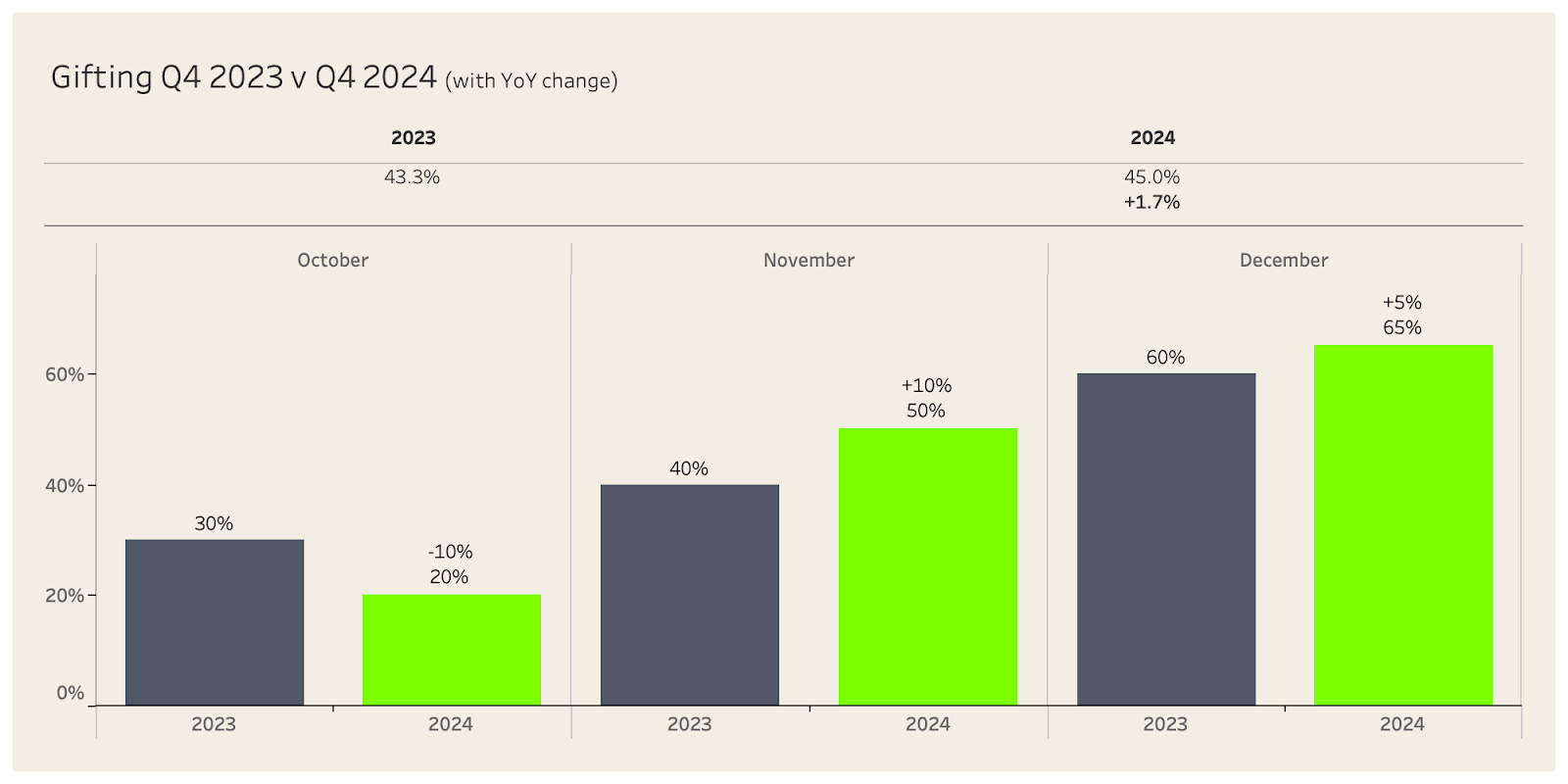
Even outside of Q4, gifting is a big area, with many of our fashion clients seeing 15-20% gifting in order confirmation surveys. I still think this is something people should allow for as BAU and things like gift landing pages, gift messaging, gift invoice option should be a minimum, along with a solid gift card solution etc. You can also see a graph below for Q4 gifting numbers amongst a data-set of ~200 brands using Census and asking this question.
14) Personalisation and segmentation
It’s getting easier and easier to deploy personalisation now (primarily for those on Shopify), with a number of new vendors offering more cost-effective solutions that are also more tightly integrated. We’ve been using Visually quite a bit recently to support both personalisation (via key segments) and testing. Shopify are in the process of introducing more functionality in this area natively (think theme editor with customer segments), which will push the industry also
Final thoughts
As we head into 2025, the market is going to remain competitive but the silver lining is that brands are finding new ways to stand out with improved creative, smarter market expansion and better use of technology.
We're very bullish on 2025 and think there's going to be a lot of room for brands to grow (globally) and also achieve more with less budget.
Subscribe to our newsletter
Our monthly newsletter is designed to be the most actionable and inspiring eCommerce newsletter in existence, combining examples of eCommerce innovation, benchmarking insights from the industry, and the latest news and eCommerce trends.
By signing up you are agreeing to our privacy policy.