Published: Oct 2024
Type: Paid Media, eCommerce
Category: Fashion

How Wholesale Agreements can Impact Conversion Rates and Key Digital Strategies to Counteract It
In a modern eCommerce environment, pricing strategies and wholesale influence play a key role in shaping consumer behaviour and, ultimately, conversion rates. From dynamic pricing to tiered discount structures, brands can leverage various approaches to maximise profit margins, but these strategies can sometimes backfire, leading to price sensitivity or hesitancy at the checkout.
The influence of wholesalers, who set their own pricing policies, can create further complexity. This is especially the case within the fashion vertical for which balancing the focus of DTC (direct-to-consumer) sales with wholesale exposure and growth is a common issue.
As brands navigate these challenges, paid media strategies can be powerful tools to counteract the negative effects of pricing dynamics.
How wholesale partnerships affect DTC conversion rates (and how to tackle it)
Partnering with a wholesale distributor is an appealing choice for many fashion brands. While online-only retailers have largely replaced department stores as the main wholesale channels, chain stores continue to hold significant importance in the industry.

UK fashion label The Vampire’s Wife recently attributed its closure to challenges in the wholesale market, and other brands have also highlighted wholesale issues in their financial reports. “Despite a period of positive growth and sales, the upheaval in the wholesale market has had dramatic implications for the brand” Guardian, 2024.
This was mostly attributed to over reliance on the online luxury fashion retailer Matchesfashion. The collapse of Matches has affected both established and emerging luxury British brands. Burberry, Anya Hindmarch, Paul Smith and Samantha Cameron’s Cefinn have all reported large sums owed as a result of Matches collapse (Guardian, Business, 2024).
Working with large retailers can give fashion brands instant recognition and exposure to a larger audience. However, the lack of control regarding product mix and promotion cycles often results in declining DTC conversion rates. The interplay of pricing strategies and wholesale is key to evaluate before any agreement.
- Promotional Flexibility: Wholesale pricing often allows retailers the flexibility to run frequent promotions or flash sales without severely impacting their profit margins. These promotional strategies can drive short-term spikes in conversion rates.
- Customer Perception and Trust: Consistent, fair pricing (made possible by wholesale savings) can enhance customer trust and lead to higher conversion rates over time. Conversely, perceived price gouging or frequent price changes without clear reasoning can reduce trust and lower conversion rates.
Finding the balance of this is key to scaling effectively - brands must consider the advantages and disadvantages of wholesale:

For many shoppers, price is a primary factor in deciding where to buy. While brand loyalty plays a significant role and can often sway users to purchase directly from the brand’s site, economic challenges and reduced disposable income lead price-savvy consumers to often scan multiple sites to find the best-priced product.
From a paid perspective, Google Shopping amplifies this by presenting price as one of the most prominent details in search results, making it harder for higher-priced listings to convert users into customers.
Google Shopping is a key platform for effectively scaling most eCommerce fashion brands, however, when competing on scaling the same SKUs against eCommerce giants - cost per click will inflate and conversion rate will most likely fall. Pricing, stock, and distribution all become factors in influencing buying decisions.

What strategies can be employed to support DTC growth over wholesale dominance?
Online exclusives
A key recommendation that we suggest is ensuring exclusivity within the product mix across both eCommerce and paid media strategies. Whether this is in the form of brandwide wholesale agreements or smaller DTC product launches, this often is a key factor in swaying users to purchase directly from the brand’s site.
Steve Madden gives a key example of this across their site, highlighting products that can only be bought directly from their online store. This gives a clear edge over any pre-existing wholesale agreements while still benefiting from stocking other products on large retailer sites.
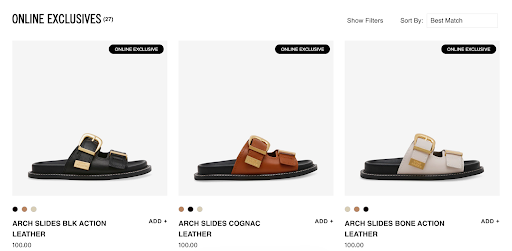
A.P.C have also recently launched this product mix feature across their US site. We suggest that eCommerce retailers take a similar approach, starting with a small and bespoke collection first to measure the impact before expanding.

From a paid media perspective, scaling exclusive products can be highly successful. Simply using custom labelling to segment out these products to then employ across all PLA based advertising mediums. Standard Google Shopping, Performance Max, Meta Dynamic Product ads and demand generation ads can all benefit with online exclusive product segmentation.
Including ‘Online Exclusives’ within the image product URL will also greatly help your listing stand out in Google auctions and Meta shopping experiences.

Margin based bidding
Whilst ‘Margin based bidding’ has become a commonly used phrase in marketing over the past few years, it is an important feature to consider. Overall, if scaling your paid media and eCommerce efforts are profitable in the back end, long-term wholesale relationships can coexist and conversion rate may not be the ‘be all and end all” of online growth.
A main deterrent within wholesale stocking is margin using third party distributors that can slash overall profit margin. Retailers must balance wholesale costs with pricing strategies to ensure profitability without deterring customers. Strategic use of margin-based bidding strategies can greatly boost ‘the right’ conversions and overall margin. Instead of simply aiming for the lowest cost per click (CPC) or cost per acquisition (CPA), margin-based bidding focuses on maximising profitability by factoring in the margin of each sale.
Google is greatly improving the capability to optimise towards and report on margin. We’d recommend including COGS (cost of goods sold) in your metrics, especially when scaling during promotional periods or when relying heavily on google shopping.
You may provide COGS data in 3 ways (Source: Google):
- Through your product feed
- Through the Content API
- By creating a supplemental feed and providing estimates or values for individual products
Google is also planning to release a feature for gross profit optimisation to implement this bidding data through AI bidding. This should help eCommerce brands decipher the right product mix to promote.
Maximising Conversion Rates through DTC Loyalty Programs
As mentioned earlier, loyalty programmes and DTC initiatives can often outway pricing undercuts from wholesalers. Fashion loyalty programs can significantly improve conversion rates compared to traditional wholesale channels by offering more personalised, engaging, and profitable experiences for both brands and customers.
Unlike wholesale channels, where the relationship between the brand and the end consumer is indirect, DTC loyalty programs allow brands to interact directly with their customers. This direct interaction fosters brand loyalty and trust, which leads to higher conversion rates. Brands can engage with their customers more personally, offering tailored promotions that wholesalers typically cannot.
Paul James’s approach to both new and existing audience incentives is interesting as they offer incentives throughout the user journey, from following on Instagram to reviewing a product. This model helps significantly sway the benefits of purchasing directly over any wholesaler that might be more dominant in the eCommerce space.

DTC fashion loyalty programs give brands more control over customer engagement, personalisation, and incentives, leading to improved conversion rates compared to the wholesale model. By fostering direct relationships, offering exclusive benefits, and delivering a seamless brand experience, DTC loyalty programs encourage repeat business and strengthen brand loyalty in ways wholesalers simply cannot.
Final thoughts
- Wholesale offers quick exposure but compromises on profit, pricing, and customer control.
- DTC enables personalised customer experiences, stronger relationships, and better profit margins.
- Paid media strategies like margin-based bidding and exclusive product promotions can mitigate wholesale challenges.
- Loyalty programs build long-term customer relationships beyond price competition.
- Brands should balance DTC and wholesale, using exclusive offerings and strategic pricing to drive conversions and increase profitability.
Subscribe to our newsletter
Our monthly newsletter is designed to be the most actionable and inspiring eCommerce newsletter in existence, combining examples of eCommerce innovation, benchmarking insights from the industry, and the latest news and eCommerce trends.
By signing up you are agreeing to our privacy policy.