Published: Oct 2023
Type: Paid Media
Category: Paid Search, Paid Social, Customer Acquisition

A Guide to CAC & CLTV through the Lens of Paid Media
Brands are becoming increasingly conscious of improving customer lifetime value (CLTV) in order to maximise profitability and justify rising customer acquisition costs. It is generally accepted that customers with a long-lasting relationship with a brand are more profitable than those who only purchase once, but is this metric alone a true measure of profitability?
As metrics become increasingly difficult to measure (due to the impact of privacy changes) and costs continue to rise, many brands are turning to a CLTV:CAC ratio to truly measure success.
- CLTV (customer lifetime value) refers to the net worth of a customer over time, through repeat purchases, subscriptions and more.
- CAC (customer acquisition cost) is the cost to the business to acquire a customer, and so has a clear interplay with paid media.
- Together, they form the CLTV:CAC ratio, to denote profitability.
Why is it important to incorporate the CLTV:CAC ratio into decision making within paid media, and what strategies can you use to maximise this ratio and increase profitability?
How to calculate CLTV, CAC and CLTV:CAC ratio
Calculating CAC is fairly simple - take your paid media spend, and divide this by the number of new customers. Many brands would also benefit from diminishing returns modelling to ascertain your CAC and incremental CAC to establish new customer profitability.
The main step for evaluating your CLTV involves finding a CLTV metric on your relevant eCommerce platform. In Shopify, for example, you can find a ‘Customer Cohort Analysis’ reporting view as seen below:
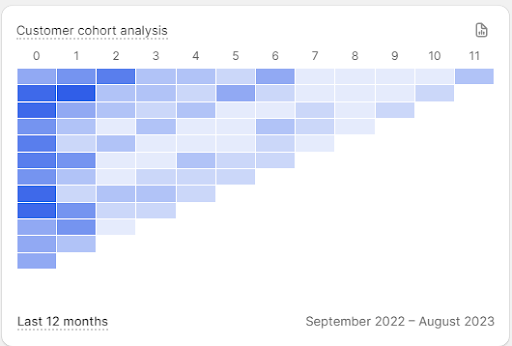
The above report, or similar, will provide you with the CLTV over the past 12 months, and so can be used in calculations for the CLTV:CAC ratio.
However, this does not take into account your margins and if you want to go the extra step, you can factor in gross margin - to ensure the actual profit per customer is calculated. For example, if your gross margin is 40%, multiply CLTV by 0.4.
Once both CLTV and CAC have been calculated, simply divide CLTV by CAC to calculate the CLTV:CAC ratio. For example, if your CLTV is £100 and your CAC is £20, your CLTV:CAC ratio would be 5:1.
What is a good CLTV:CAC ratio?
Every business is different, as is every vertical, and so benchmarketing specific CLTV and CAC is not always helpful. This is due to variance in price points, purchase frequency and AOV. Therefore, the CLTV:CAC ratio is a more comparable metric.
1:1 Ratio
A 1:1 ratio is a situation where the cost to acquire a user is the same as the customer lifetime value. While this appears to be breaking even, the above calculations do not factor in fulfilment, tax, shipping etc, and so would actually represent a loss - you need to make your ratio has some buffer in there.
2:1 - 3:1 Ratio
CLTV is 2-3x higher the cost to acquire the customer. This usually represents a brand prioritising growth, aiming for a higher CAC due to heavy investment in new customer acquisition. 3:1 is commonly considered to be a ‘good’ ratio, balancing both new customer acquisition and efforts to improve CLTV long term.
>4:1 Ratio
This is a very healthy ratio and brands with a CLTV this high have a lot of room for growth, as you can use this additional budget and re-invest into new customer acquisition.
How to improve customer acquisition costs?
Acquisition costs are often tackled with reducing budgets. While this can often have an impact in the short term, the long term impact is reflected in falling new customers, a poorly seeded customer base and stifled growth. Below are three ways to improve customer acquisition costs:
1) Maximising the funnel
Best practice on Meta usually requires the funnel to be split out, with Prospecting, Remarketing and Retention targeted in separate campaigns. This gives the advertiser greater control over where budget is invested, and therefore the ability to influence CAC.
Whilst prospecting and retention are important, remarketing represents a significant opportunity to nudge stubborn customers to a purchase. Making full use of the funnel in this way avoids expenditure being wasted, by re-engaging with higher intent users who have been served ads already but not converted and therefore improving CAC overall.
2) Audience optimisation
Optimising audiences to become more relevant, and of higher intent or quality is a favourable alternative to reducing spend. This ensures the budget is being directed towards high-intent users, driving more efficient CACs.
How can we achieve this on Meta?
- The lookback window: Experiment using shorter lookback windows for audiences for high intent actions such as ‘Add to Cart’. This reduces the size of the audience, limiting it to users who have completed the desired action more recently, therefore increasing the likelihood of purchase when remarketed.
- Lookalike percentages: Test smaller percentage lookalike audiences. This will create a narrower audience of accounts similar to the seed audience, thereby enabling similar users of high-intent to be identified.
How can we achieve this on Google, with Performance Max?
- Bidding higher for new customers: To bid higher for new customers in Google, we can specify the ‘new customer acquisition value’ and provide customer lists so that Google can separate new vs. existing customers - and from this, we can bid higher for new customers only.
- Only bidding for new customers: This simply limits bidding to new customers, determined by customer lists uploaded to Google as above.
3) Streamlining the purchase pathway
Creating a frictionless user experience from ad to purchase is essential. This acts to reduce bounce rates, and maximise marketing efforts to acquire users. How can we facilitate this?
- Express payment: Apple pay facilitates rapid checkout and payment on PDPs, reducing the likelihood of a user delaying purchase.
- Landing page optimisation: Take an active role in optimising and testing landing pages. Send users to pages with the highest Conversion Rate (CVR), or A/B test your landing pages.
- Inject similar products above the fold: Include similar products above the fold on PDPs as a fallback option, just in case the size or colour a consumer is interested in is out of stock.
- Sizing guides: Unclear sizing represents a significant barrier to purchase for many consumers. Therefore, providing product-specific sizing guides can improve the user experience, and lessen barriers leading up to a purchase.
How to improve customer lifetime value?
Customer lifetime value should be tackled with a multi-channel approach. Your customer data is invaluable, highly versatile and dynamic (especially when using Klaviyo or Ometria with integrations to Meta or Google). Customer data can be segmented to build groups of customers based on valuable actions, such as AOV, Frequency of Purchase and the type of product purchased. Below are key strategies to elevate CLTV:
1) Target lapsed users
Lapsed users are commonly defined as customers who make a purchase, and do not purchase again. This represents a significant loss regarding the investment used to acquire the user, as their CLTV will be incredibly low, thereby most likely making a loss when taking into account all costs. Therefore, we can aim to rectify this by serving such users curated content to motivate them to purchase again.
Create an audience of users who have not purchased within the last 6 months, and serve them messaging such as ‘we miss you’, ‘here’s what you’ve missed’ or ‘have 10% off on us’ to re-engage their interest. This works particularly well on paid social.
2) Target VIP customers
VIP customers are a brand’s loyal user-base, who purchase frequently at a high AOV. Given this, they represent a key resource at a brand’s disposal, and we can target them in many ways:
- Refer a friend schemes are an excellent way to leverage VIP customers, not only from a new customer acquisition perspective, but increasing their own customer lifetime and purchase frequency. This can be achieved by offering VIPs ‘10% Off Your Next Order’ when they refer a friend.
- Social proof is an excellent way to build trust across the funnel, by including reviews in ads and testimonials on site. While this may not directly increase CLTV, it brings the consumer closer to the brand, engaging them and creating the feeling of contribution and adding value. This all helps to strengthen the affinity they feel with the brand, and therefore can indirectly foster stronger CLTV long term.
While these schemes are not exclusive for VIP customers, these users are more likely to refer friends, leave reviews or agree to participate in testimonials.
3) Cross-selling products
Cross-selling involves motivating users to purchase additional products which compliment the original product bought. For example, fashion brands can create a customer list of users who purchased a pair of jeans, but not footwear. On Meta, this audience can be served footwear content with messaging such as ‘the perfect pairing’ or ‘match your jeans with the perfect pair of shoes’ and on Google, this audience can be served Shopping ads limited to shoes, or shoe related copy.
4) Bundles
Bundles are a form of cross-selling, and are a great way to increase AOV, and therefore CLTV long term. Bundling most commonly involves grouping complementary products together (e.g. hoodies and track pants) under one SKU so only one product has to be added to cart, usually at a lower price than purchasing these items individually. Bundling can also be used for:
- Controlling stock velocity: Pairing fast and slow moving products, to shift excess stock. The incentive being a more popular product, paired with lower demand items.
- Buy in bulk: Offering bundles for the same product, driving users to buy the same product in bulk upfront. This helps save on shipping costs while simultaneously increasing AOV.
- Commonly bought together products: Leverage data to see which products are most commonly bought together, to build strong opportunities for bundling.
5) Loyalty programs
Loyalty programs most commonly involve users accumulating points when purchasing which results in rewards and unique offers, driving continued higher purchase frequency. This is a very cost effective way to re-engage existing customers, encourage customer referrals (due to them enjoying the benefits of the loyalty program) and incentivise reviews as a way of earning points.
How do sale periods impact CLTV and CAC?
Sale is a longstanding strategy to boost customer acquisition, however there have always been questions over the value of a customer acquired during a markdown period. Customers acquired through sale often would not have purchased at full price and therefore yield a lower repeat purchase rate, at a low initial AOV.

Above, we can see example data from a fashion brand, and we can clearly see a spike in customer acquisition during November 2022 (during the Black Friday period). Interestingly, while total customer acquisition increased, CLTV for the following period was significantly lower than September and October, which was a full price period.
Therefore, while sale is an impactful acquisition tool, the longevity and value of these customers must be taken into consideration. Sale customers could be treated as a warm remarketing audience, rather than high-intent retention, due to them needing more convincing to purchase at full price.
Final thoughts
It can be easy to focus on day-to-day metrics, and while this has its place in making a paid media strategy more sophisticated, this can lead to overlooking the big picture. Analysis of CLTV and CAC allows brands to evaluate the long term success and profitability, the health of marketing and where efforts must be improved. With this, comes several key elements to consider:
- Benchmarking this ratio is important, to ensure marketing efforts align with business goals. The ideal ratio sits around 3:1, balancing out growth of customer acquisition and maximising customer lifetime value.
- Paid media can help improve the efficiency of CAC, and drive stronger CLTV. Improving CAC is supported through campaign structure, audience optimisation and pathway streamlining, whilst CLTV is supported through customer segmentation and on-site loyalty and community engagement tools.
- Sale can hinder long term CLTV, but acts as a strong acquisition piece. Therefore during sale, it is worth evaluating whether the CLTV:CAC ratio is actually affected if CLTV is significantly lower than the cost to acquire the user during sale compared to a full price period.
If you would like support in building a paid media strategy to support CAC and CLTV, please do not hesitate to contact us.
Subscribe to our newsletter
Our monthly newsletter is designed to be the most actionable and inspiring eCommerce newsletter in existence, combining examples of eCommerce innovation, benchmarking insights from the industry, and the latest news and eCommerce trends.
By signing up you are agreeing to our privacy policy.